
Here's a thought that should keep every NEET 2027 aspirant up at night — in the best possible way.
The first NEET 2026 paper got cancelled.
Gone. Scrapped. A fresh paper written from scratch by a new set of people, with one job: be unpredictable. No leaks. No repeats. A clean slate designed so that nobody — no coaching institute, no app, no question bank — could have seen it coming.
178 of those 180 Re-NEET questions were already sitting in Darwin's question bank.
Read that again. They rewrote the entire exam to make it impossible to predict. And we still predicted 99% of it.
In Re-NEET 2026, Darwin had a strike rate of 99%.
That's not luck. Luck doesn't survive a total rewrite. That's a pattern so deep that even the people setting the paper can't escape it.
This blog is about why that happened — and why it should change how you prepare for NEET 2027 starting today.
Nobody Gets Lucky Twice on Two Different Papers.
Re-NEET 2026 wasn't a one-off success. Even in the cancelled NEET 2026 paper, Darwin's question bank delivered 99.5% Strike Rate. Had that exam stood, countless Darwin students were on track for 700+ scores. The 178 out of 180 matches in Re-NEET simply confirmed the predictive power and precision of Darwin's academic research.
Re-NEET 2026 silenced every one of them.
Because this wasn't the same paper. It was a different set of questions, written after the first one was thrown out, specifically to be new. There was nothing to leak, nothing to copy, nothing to game.
And Darwin's question bank still lined up with 99% questions matched — practiced, explained, and solved by our users before they walked into that hall.
When you hit a number that high on a paper that was engineered to be unguessable, only one explanation is left:
NEET has a pattern. And we've spent years learning to read it better than anyone else.
Check out our past strike rate history:
- Darwin had a 99.5% strike rate in NEET 2026. 179 out of 180 questions were already in Darwin's Question Bank
- Darwin had a 97% strike rate in NEET 2025. 175 out of 180 questions in NEET 2025 were directly from Darwin's Question Bank.
- Darwin had a 99.5% strike rate in NEET 2024. 199 out of 200 questions came from Darwin's Question Bank.
- Darwin had a 99% strike rate in NEET 2023. 198 out of 200 NEET 2023 questions were from Darwin's Question Bank
- Darwin had a 98% strike rate of NEET 2022. 196 out of 200 NEET 2022 questions came directly from Darwin's Question Bank.
The Numbers, Subject by Subject
A 99% strike rate isn't a slogan we put on a banner. It's something you can count, question by question.
Let's talk about numbers.
In Physics, this year we had 44 out of 45 repeats in Re-NEET 2026. Here is one such question. Check how close we came to the actual NEET 2026 question.
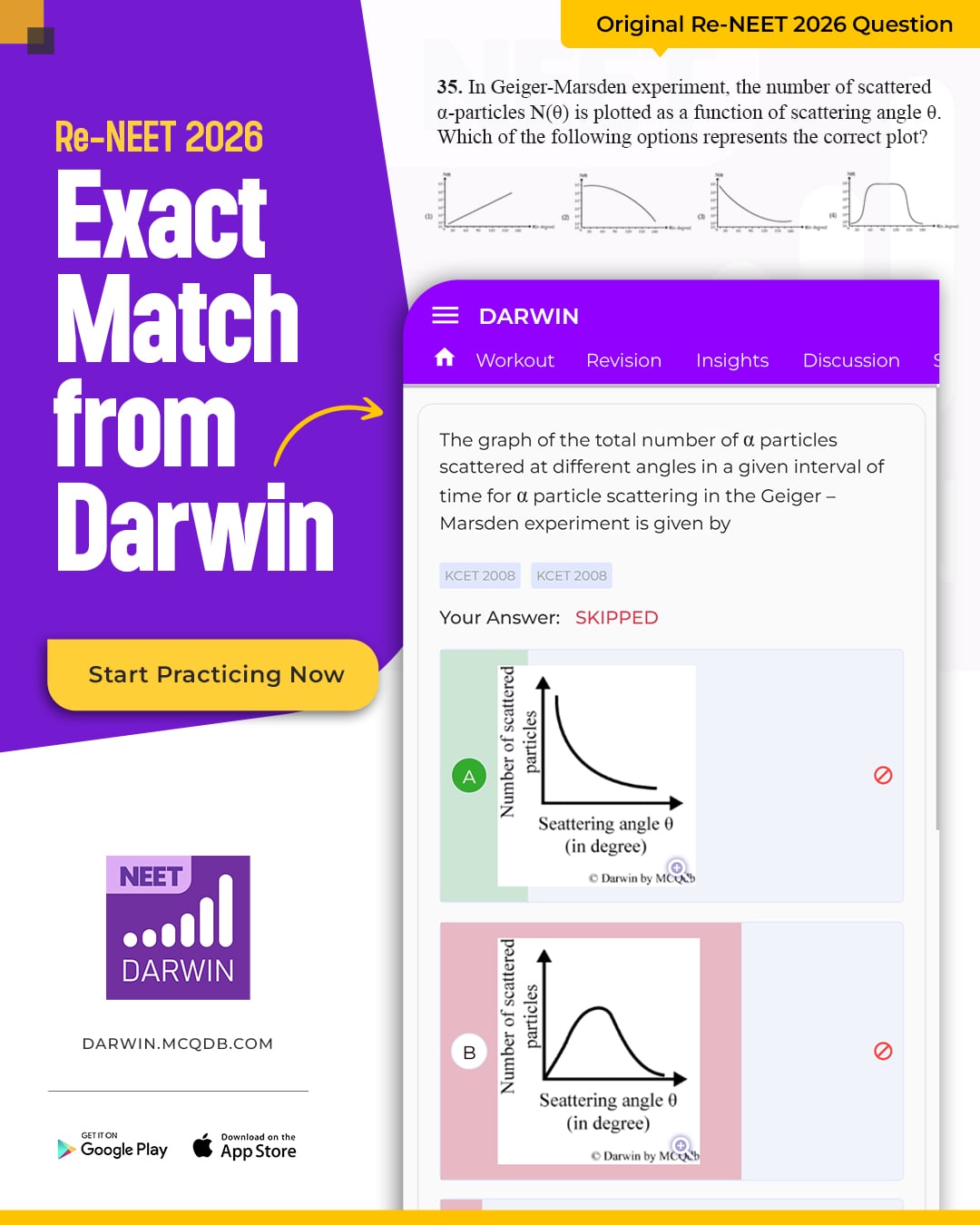
Click here to access this exact question on Darwin.
In Chemistry, we had 100% Strike Rate. 45 out of 45 repeats in Re-NEET 2026 from our Q-bank.
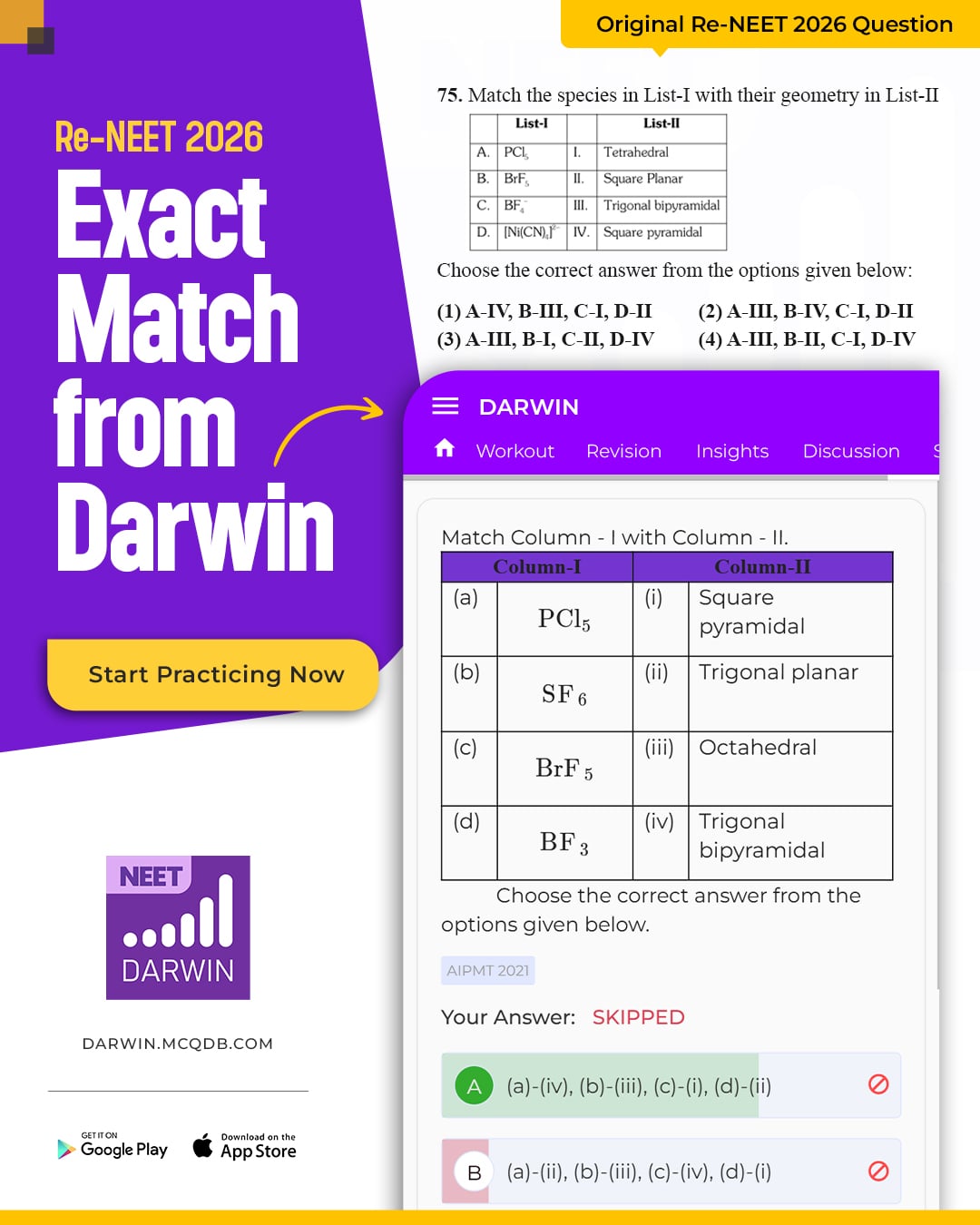
Click here to access this exact question on Darwin.
And in Biology, we had 89 out of 90 repeats in Re-NEET 2026.
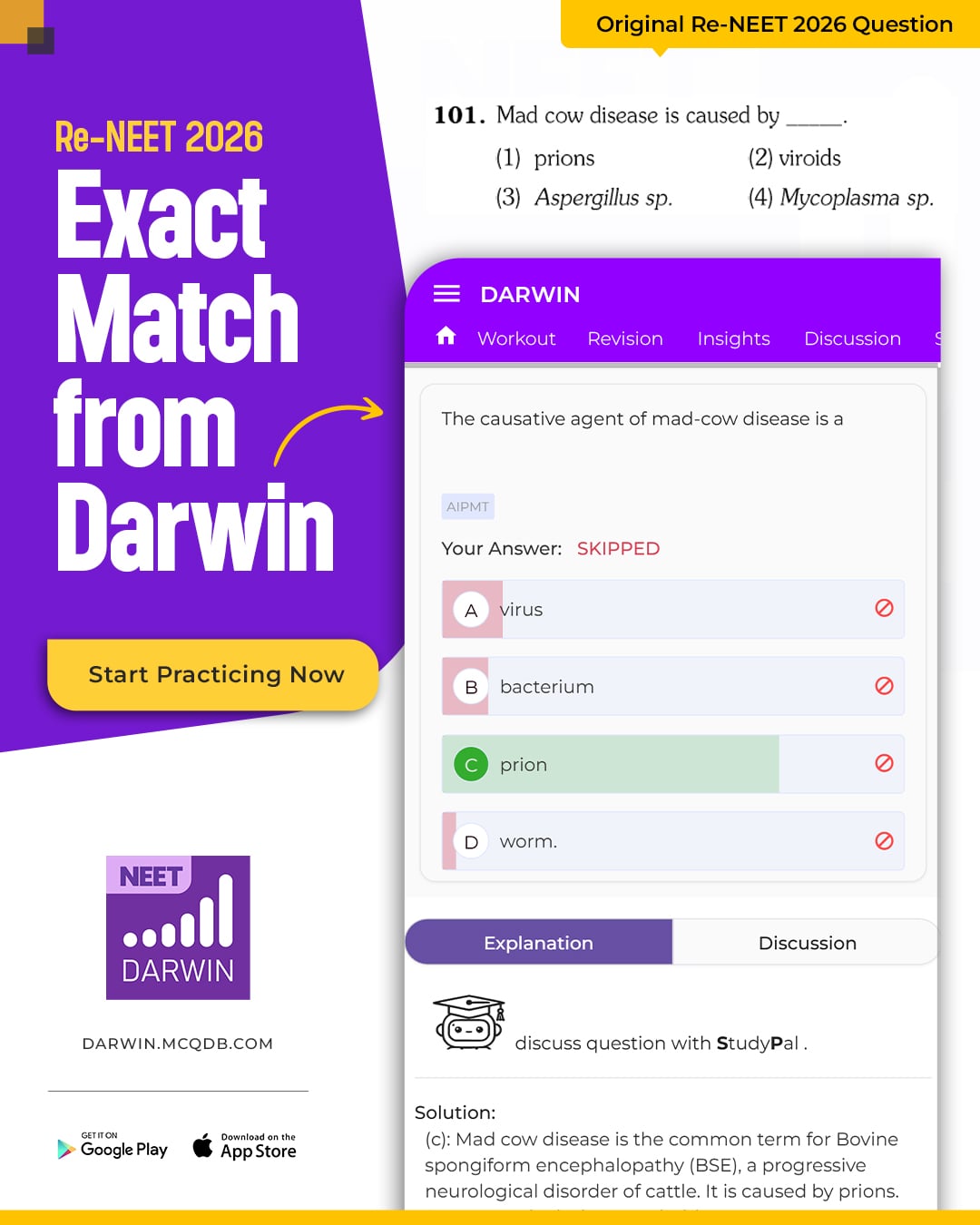
Click here to access this exact question on Darwin.
Not "similar to." Not "based on the same chapter." The same concept, the same depth, the same trap, the same way of thinking the question demanded.
This is what exam-ready is supposed to mean.
Click here to check out the full set of NEET 2026 questions and Darwin's match in our other blog.
A Different Paper Made the Same Choices
When the re-exam was announced, the safe assumption was simple: a new paper means new questions. Any question bank that had matched the original exam would struggle to repeat that success—yet Darwin did.
That's not what happened. And the reason is worth sitting with.
A NEET question paper isn't written in a vacuum. Whoever sets it is bound by the syllabus, by the weightage NEET has used for years, by the difficulty band a national entrance exam has to stay inside, and by an unspoken sense of what a "fair" NEET question looks like.
Those constraints don't loosen just because the previous paper got binned. If anything, a rushed re-exam leans harder on the safe, proven, exam-tested moulds — there's no time to get experimental.
So, a brand-new set of authors, writing under pressure, reached for the same concepts at the same depth — because those are the only places the exam is allowed to go.
That's what a five-year strike rate is really measuring: not how long a question bank has existed, but how consistently it has evolved—updated every year and recalibrated every time NTA introduces even the smallest syllabus change.
Not our memory of old papers. The narrow, fixed corridor NEET is forced to walk down every single year. We've mapped that corridor question by question, and we keep remapping it after every paper — so when the examiners reach for their next "fresh" question, it's already waiting in the bank.
The re-exam didn't beat that corridor. It walked right down the middle of it.
What This Means For You — NEET 2027 Aspirant
Right now, somewhere, two students are preparing for NEET 2027.
The first one is doing everything that feels productive. Thick notes. Chapters finished. Topics ticked off a list. Working genuinely hard — and walking into the exam hall hoping the paper is kind.
The second one is on Darwin. They're not just covering the syllabus. They're learning what NEET actually rewards — the specific concepts, the specific depth, the specific way questions get framed — and building muscle memory around exactly that.
When the paper arrives, the first student is suprised.
The second student sees a room they've already been in.
That's the entire difference between a 500 and a 700. NEET doesn't only test what you know — it tests how fast you recognise what's being asked beneath the surface. Pattern recognition under pressure is what turns preparation into marks. And you can't cram it in the final month. It compounds, quietly, every week you train for it.
The Closest You Can Get to NEET 2027
The real choice for a NEET 2027 aspirant isn't which app or how many notes.
It's this: do you want to meet the paper for the first time on exam day — or for the hundredth time?
Darwin can't hand you the actual paper. Nobody can, and you should run from anyone who claims they will. What we can do is something quieter and far more powerful: put you in that exam hall so many times before it counts that the real thing feels like a memory, not a surprise.
178 out of 180 on a paper engineered to be unbeatable.
That number isn't a finish line we're celebrating. It's a measurement of how predictable NEET stays for the students who decode it early — and how much of your score is already decided, long before results day, by where you choose to put the next few months.
The exam keeps showing its hand.
Start reading it before everyone else does. Start with Darwin